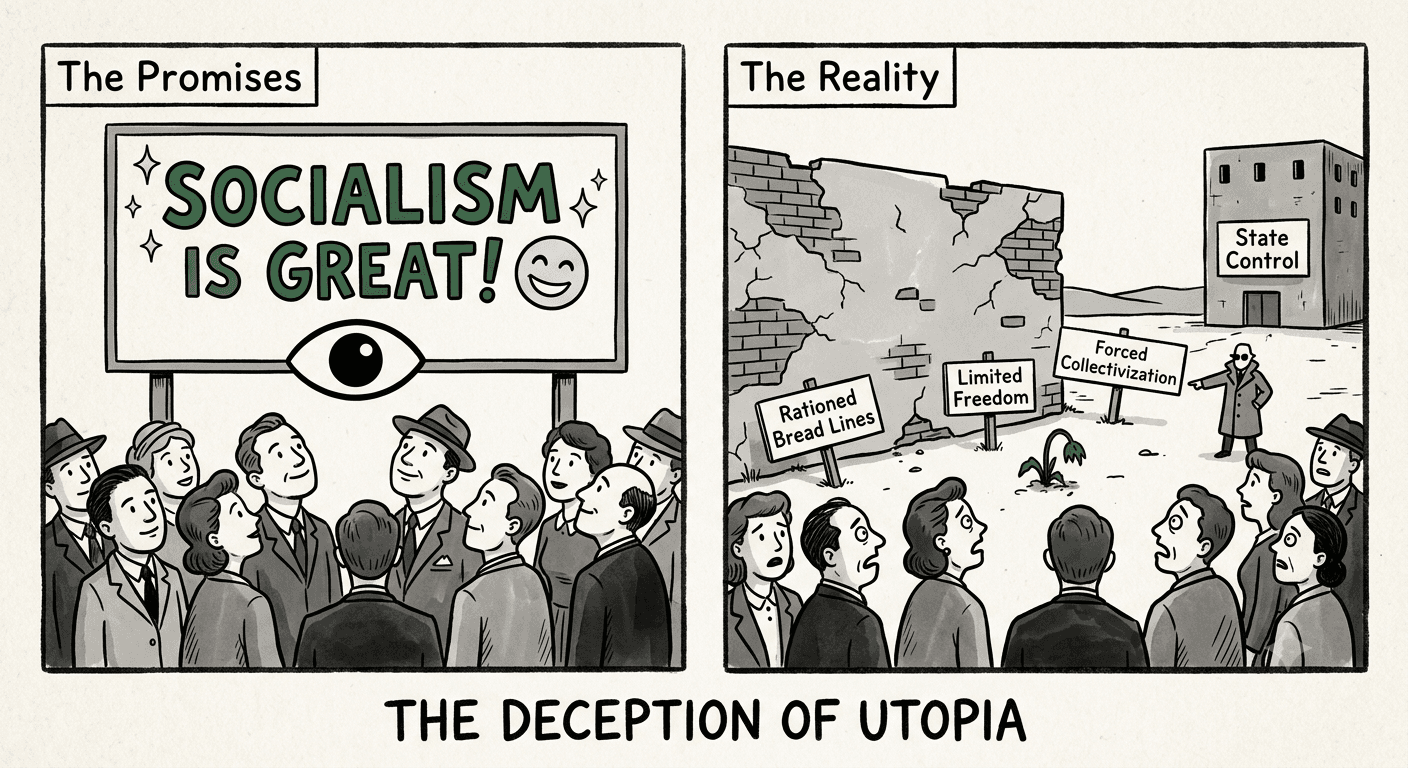
Socialism Sounds Great Until You Look at How It Actually Works
Share
62% of young Americans say they support socialism. We get why. We also think they're wrong. Here's our case, and an open invitation to argue back.
Here is a number worth sitting with: 62% of Americans between the ages of 18 and 29 say they hold a favorable view of socialism. That is not a fringe position. That is a majority of your generation, according to a 2025 Cato Institute and YouGov poll of 2,000 Americans.
We are not going to pretend that number does not exist. We are not going to call those people stupid or lazy or naive. The frustrations driving it are real. Housing costs have risen over 54% since 2020. Student debt is crushing. A lot of young people looked at the economy they inherited and concluded that the system is rigged against them.
They are not entirely wrong about the frustration. They are wrong about the diagnosis. And they are very wrong about the cure.
This piece is our case. Read it, disagree with it, and then come argue with us about it in person. We mean that. The invitation is at the bottom.
What Most People Mean When They Say Socialism
Before we get into the argument, we have to be clear about what we are actually debating, because "socialism" means different things to different people.
When the Gallup organization studied this in 2021, they found something revealing. Young people who said they supported socialism still held an 83% favorable view of "free enterprise." That is not a contradiction in the sense that most people think. It means that when a lot of young Americans say they want socialism, they do not mean the Soviet Union. They mean they want fairness. They want affordable health care. They want housing they can afford. They want a system that feels like it is working for them and not just for the people who already have everything.
That desire is legitimate. The disagreement is over how to get there.
The version of socialism that has actually been implemented at scale, not the Scandinavian welfare state that everyone references, which runs on top of a heavily market-based economy, but the real thing, central planning, state ownership of industry, government control of prices and production, has a track record. And it is not a good one.
What Socialism Has Actually Produced
The 20th century ran the experiment at enormous scale. The Soviet Union built a command economy across 11 time zones and collapsed under the weight of its own inefficiency in 1991. Venezuela had the largest proven oil reserves in the world and nationalized its energy sector under Hugo Chavez. By 2019, Venezuelans were losing an average of 24 pounds per year due to food shortages. Cuba's economy has been in managed decline for 60 years, with regular power outages and a healthcare system that works very well for government officials and very poorly for everyone else. Zimbabwe tried price controls and land redistribution in the early 2000s and produced hyperinflation so severe that the government eventually printed a 100 trillion dollar bill that could not buy a loaf of bread.
These are not cherry-picked failures. They are the most consistent pattern in modern economic history. Every time a government has tried to replace market pricing with central planning at scale, the result has been scarcity, stagnation, and eventually either collapse or the quiet reintroduction of market mechanisms under a different name.
The reason is not that socialist leaders are evil. Some of them start with genuinely good intentions. The reason is that no government, no committee, no bureaucracy, however well-intentioned, can process the millions of daily decisions that a market makes automatically. Prices are information. When the government sets them, it destroys the signal that tells producers what to make and consumers what things actually cost. The result is always the same: too much of what nobody wants and not enough of what everybody needs.
Why the Problems Young People Are Blaming on Capitalism Were Often Caused by Government
Here is the part that rarely makes it into the conversation. The specific economic problems driving young people toward socialism, the housing crisis, the student debt crisis, the rising cost of health care, were not produced by free markets running wild. They were produced by government intervention in markets that distorted prices and removed the accountability that makes markets work.
Housing is the clearest example. Home prices rose more than 54% between 2020 and 2025. From February 2020 to February 2022 alone, the federal government expanded the money supply by an unprecedented 40%, pumping artificially cheap money into the economy while the Federal Reserve held mortgage rates near zero. That flood of money had to go somewhere. It went into home prices. The result was a housing affordability crisis that working families in Walton County feel every time they look at what a starter home costs today.
Zoning laws compound the problem. Single-family zoning requirements, setback rules, minimum lot sizes, parking minimums, and permitting delays are all government policies that restrict housing supply while demand grows. The conservative answer to the housing crisis is not more government. It is less of the government that created the problem in the first place.
Student debt works the same way. The federal government began guaranteeing student loans decades ago, removing the risk from lenders and making it possible to borrow enormous sums for degrees with uncertain returns. When lenders face no risk, they have no incentive to ask whether a degree is worth the price. When universities know students can borrow whatever they charge, they have no incentive to control costs. The result is a trillion-dollar debt crisis that the government is now proposing to solve by having taxpayers absorb the bill. That is not a market failure. That is a textbook example of what economists call moral hazard, created by the government itself.
What the Scandinavian Argument Actually Shows
The most common response to the historical record is to point to Denmark or Sweden and say those are the models, not Venezuela. It is a reasonable thing to say. But it is also worth understanding what those countries actually are.
Denmark and Sweden are not socialist economies in the classical sense. They have high taxes and generous social programs, but the underlying economies are built on private property, free markets, and open competition. Denmark actually ranks higher than the United States on many measures of economic freedom. Swedish companies operate in genuinely competitive markets. The wealth that funds those social programs was built by free enterprise, not by central planning. The Scandinavian model is, more accurately, a free-market economy with an expensive welfare state on top of it. You can debate whether that is a good trade-off. But it is not socialism.
The Real Alternative
Young people who are frustrated with the current economy are right to be frustrated. The frustration is earned. But the solution is not to give the government that inflated the money supply, guaranteed student loans without accountability, and locked up housing supply through zoning laws, more power over more of the economy. That is the equivalent of responding to a leaky pipe by handing the plumber a bigger wrench after he already flooded your basement.
The conservative argument is that the path to affordability, to financial independence, to an economy that works for people in their 20s, runs through more freedom, not less. Lower taxes that let you keep more of what you earn. Less regulation that makes it possible to build more housing. Less federal intervention in education financing that might force universities to compete on price. Local governments that develop with accountability rather than passing the costs to existing residents.
That is not an argument for ignoring inequality or pretending the system is perfect. It is an argument that the track record of free markets at producing prosperity is dramatically better than the track record of central planning. And that the specific failures people are experiencing right now have a different cause than the one being diagnosed.
We Want to Hear Your Counterargument
We mean everything in this piece. We also mean this: if you disagree, come tell us why.
The Walton County Young Republicans is not an echo chamber. We are a group of people who believe the best ideas survive real scrutiny. If you think we have gotten the economics wrong, or that free markets have caused more harm than we are acknowledging, or that there is a version of democratic socialism that would actually work here, show up and make that case.
We meet every third Tuesday at 7:00 PM at Le Gabrielle Crepes & Waffles in Downtown Monroe. There is no membership fee to walk through the door. There is no dress code. Bring your argument and a willingness to have it challenged, because we will bring ours.
Keep reading
More articles

The Conservative Movement Has Always Needed Friction. It Is How Progress Works.
By Walton YR Board · August 8, 2026
Throughout GOP history, internal friction caused by younger conservatives hasn't divided the party; it has pushed it forward.
Read More
250 Years of the Freest Nation on Earth. Don't Take It for Granted.
By Walton YR Board · July 3, 2026
Two hundred and fifty years ago, fifty-six men signed their names to a document that was, at the time, a death sentence. Here's what we owe them.
Read More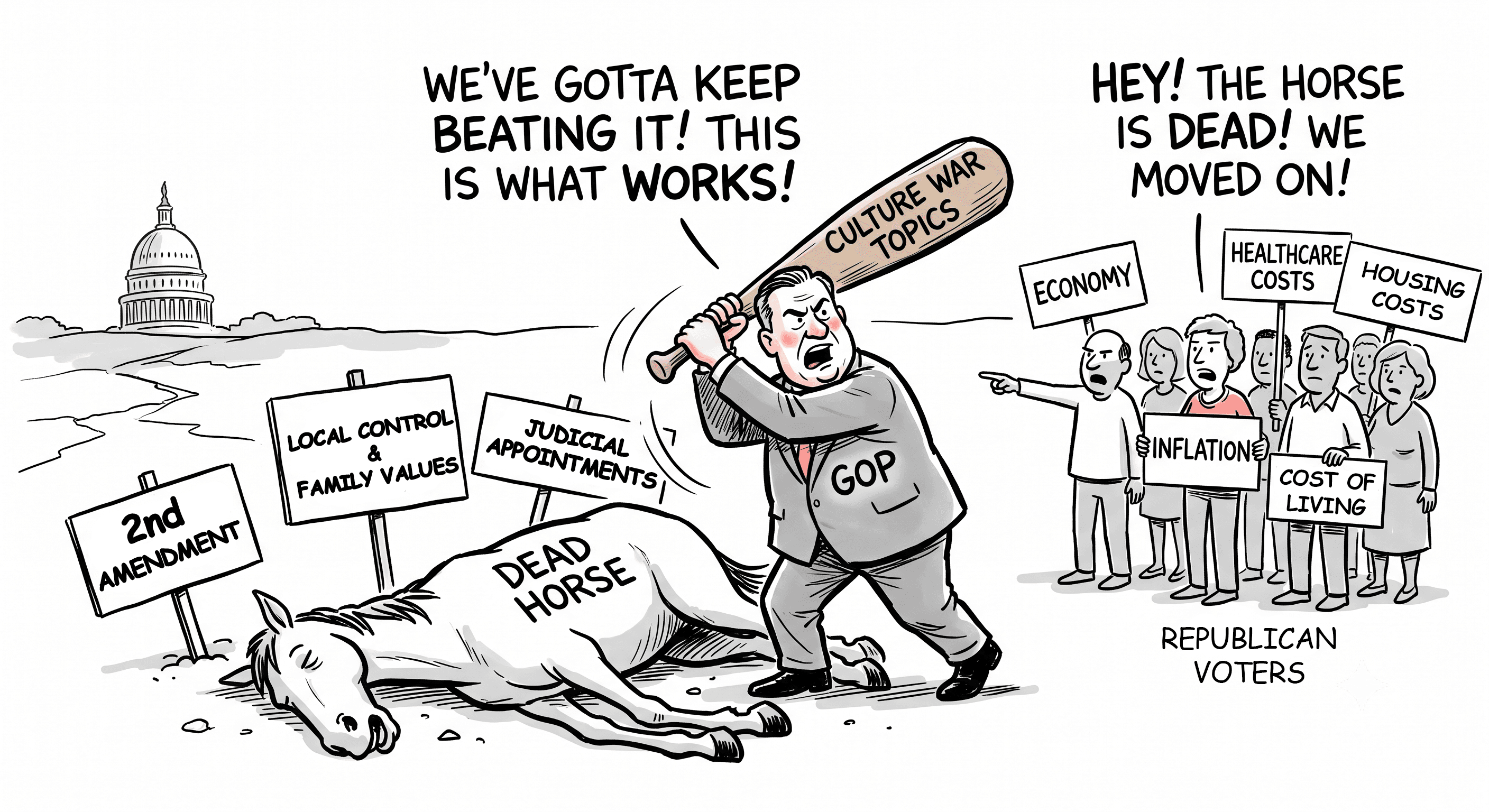
We Won the Argument. It's Time to Move On.
By John Breedlove · June 30, 2026
A party that keeps running on battles it already won is a party that has stopped thinking about what comes next. Georgia conservatives must look forward.
Read More